
Most people are actually honest most of the time and it is our expectation that people tell us the truth, thereby making it easier for them to be able to lie to us. Telling little white lies is part of our culture, we do it to be polite and to spare someone else’s feelings. It’s a nice thing to do, isn’t it?
You are lied to many times a day, sometimes you see straight through it and often you have no idea. Fortunately most of us share the same motives for lying, Paul Ekman studied this (See picture below), and they seem quite reasonable. It is a part of our daily lives.
Every now and then, though, we come across a pathalogical lyer and this is when it becomes a problem. A great lie detection test is to ask ‘why?’. It is much more difficult for someone to lie about their intentions than it is to simply make up some facts.

Normal Motives for Telling Lies
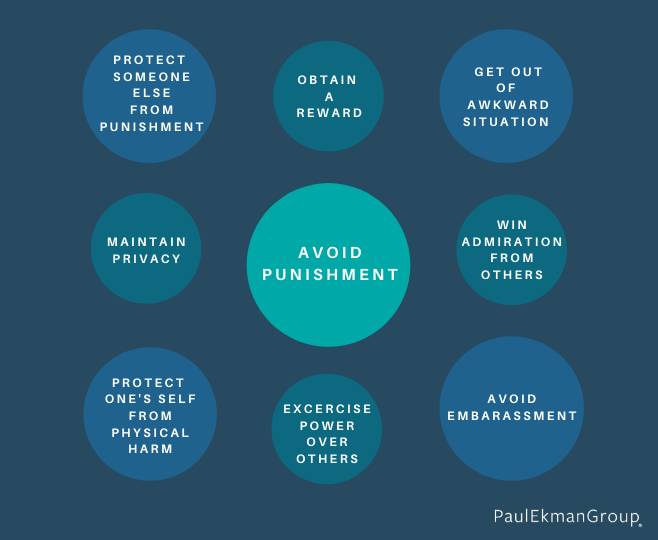
1. To avoid being punished.
2. To obtain a reward not otherwise readily obtainable.
3. To protect another person from being punished.
4. To protect oneself from the threat of physical harm.
5. To win the admiration of others.
6. To get out of an awkward social situation.
7. To avoid embarrassment.
8. To maintain privacy without notifying others of that intention.
9. To exercise power over others by controlling the information the target has.
Pathological Liars
Some people lie compulsively and their lies somehow makes sense to them. It helps to try and look through their eyes with compassion.
1. They don’t want to disappoint you.
2. They really want their lie to be true.
3. They feel like they would give up control if they tell the truth.
4. What they’re lying about is important to them, even if you don’t see the point.
5. One lie always needs another to cover it up and it continues indefinitely.
6. They don’t know that they are lying. It’s how they remember it in their minds and can create a completely diffrent world to meet their needs.






0 Comments